How SNSF WMS Manages Customer & Vendor Contracts Easily
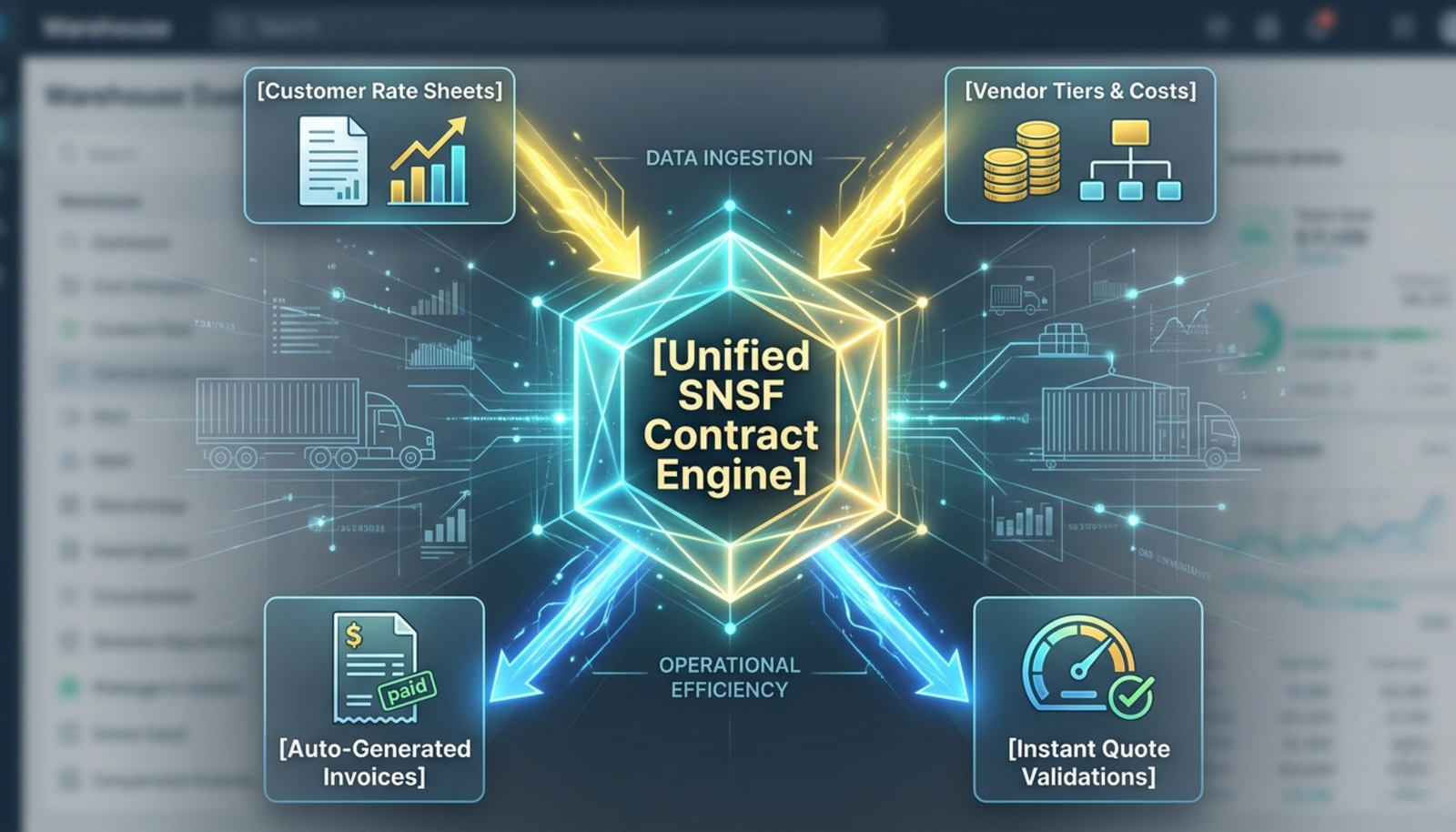
Managing warehouse billing manually often leads to revenue leakage and broken vendor relationships. In high-volume third-party logistics (3PL) environments, keeping up with multiple shifting pricing tiers is a constant challenge. Store'n Ship-Fast (SNSF) WMS solves this friction by automating contract integration for both customer and vendor rate sheets within a single unified platform.
📌 Quick Takeaway: Contract Integration Benefits
Centralized Database: Eliminates separate Excel tracking sheets for customer and vendor billing variables.
Automated Processing: Eradicates calculation errors during invoice generation and multi-principal billing.
Real-time Access: Retrieves accurate active pricing models instantly during quotation workflows.
Why is WMS Rate Sheet Management Critical for Modern Warehouses?
WMS rate sheet management is the process of centralizing and automating storage, handling, and fulfillment fees to ensure accurate billing. Without an integrated system, logistics operations face severe revenue leakage due to unbilled services, miscalculated handling charges, or outdated vendor pricing models being applied manually.
When you handle dozens of distinct logistics accounts, pricing models naturally diverge. One account might pay by pallet position per day, while another requires a flat monthly fee plus a variable charge for split-case picking. Manually tracking these distinct rules across multiple spreadsheet versions creates friction between your operations and finance teams.
What are the Benefits of Vendor Rate Integration in Logistics?
Vendor rate integration allows a warehouse management system to store, track, and verify the cost structures of third-party carriers, suppliers, and labor providers. By connecting vendor rate sheets directly to your fulfillment workflows, the software lets you compare operational costs, validate third-party invoices, and protect your profit margins.
Feature Area
Value Driven by SNSF WMS
Why It Matters
Multi-Contract Handling
Keeps track of active, past, and upcoming contract periods without overlapping data.
Eliminates manual calendar tracking and backdated auditing.
Real-time Rate Verification
Provides service desks with exact cost and margin data right during quote creation.
Protects profitability by preventing under-quoted services.
Automated Invoicing Accuracy
Automatically references current cost metrics to remove manual data processing delays.
Shortens payment cycles and prevents vendor disputes.
Managing outward customer billing is only half the battle; tracking inward third-party expenses matters just as much. For instance, when managing freight movements or specialized transport coordination, carrier costs fluctuate dynamically. Integrating vendor rate sheets directly into your primary platform gives your managers total clarity on underlying operational expenses.
How Does Multi-Contract Handling Work Across Different Periods?
Multi-contract handling manages concurrent and sequential contract lifecycles by allowing teams to store, organize, and transition between different rate versions over time. The system locks down historical billing records for compliance while automatically activating newly negotiated rates on their exact effective date.
A major bottleneck in contract management is handling annual renewals or mid-year adjustments. If an operator updates a rate sheet mid-month, raw legacy software might accidentally overwrite older transactions. This error creates accounting issues for jobs completed earlier that week.
SNSF circumvents this entirely by implementing strict version control within its database architecture. The platform segregates pricing rules by distinct, highly defined validity dates. Your team can upload next quarter's updated rate tiers today without affecting active billing workflows.
Step-by-Step: Streamlining Your Warehouse Pricing System
Transitioning away from manual documentation to a structured system like Store'n Ship-Fast requires a deliberate approach:
Centralize Active Documentation: Gather every standalone Excel sheet and PDF agreement currently used by your customer service and accounting teams.
Define Structural Variables: Map out specific charging triggers, including fixed base fees, volume tiers, and ancillary fulfillment penalties.
Upload via Integrated Templates: Import your customer and vendor rate datasets directly into the platform to eliminate manual input mistakes.
Link to Operational Workflows: Connect your rate profiles to your primary warehouse processes, like creating Goods Receipt Notes (GRN) or picking orders.
Run Parallel Validations: Compare your first few auto-generated invoices against legacy manual calculations to verify perfect rule alignment.

 When you handle dozens of distinct logistics accounts, pricing models naturally diverge. One account might pay by pallet position per day, while another requires a flat monthly fee plus a variable charge for split-case picking. Manually tracking these distinct rules across multiple spreadsheet versions creates friction between your operations and finance teams.