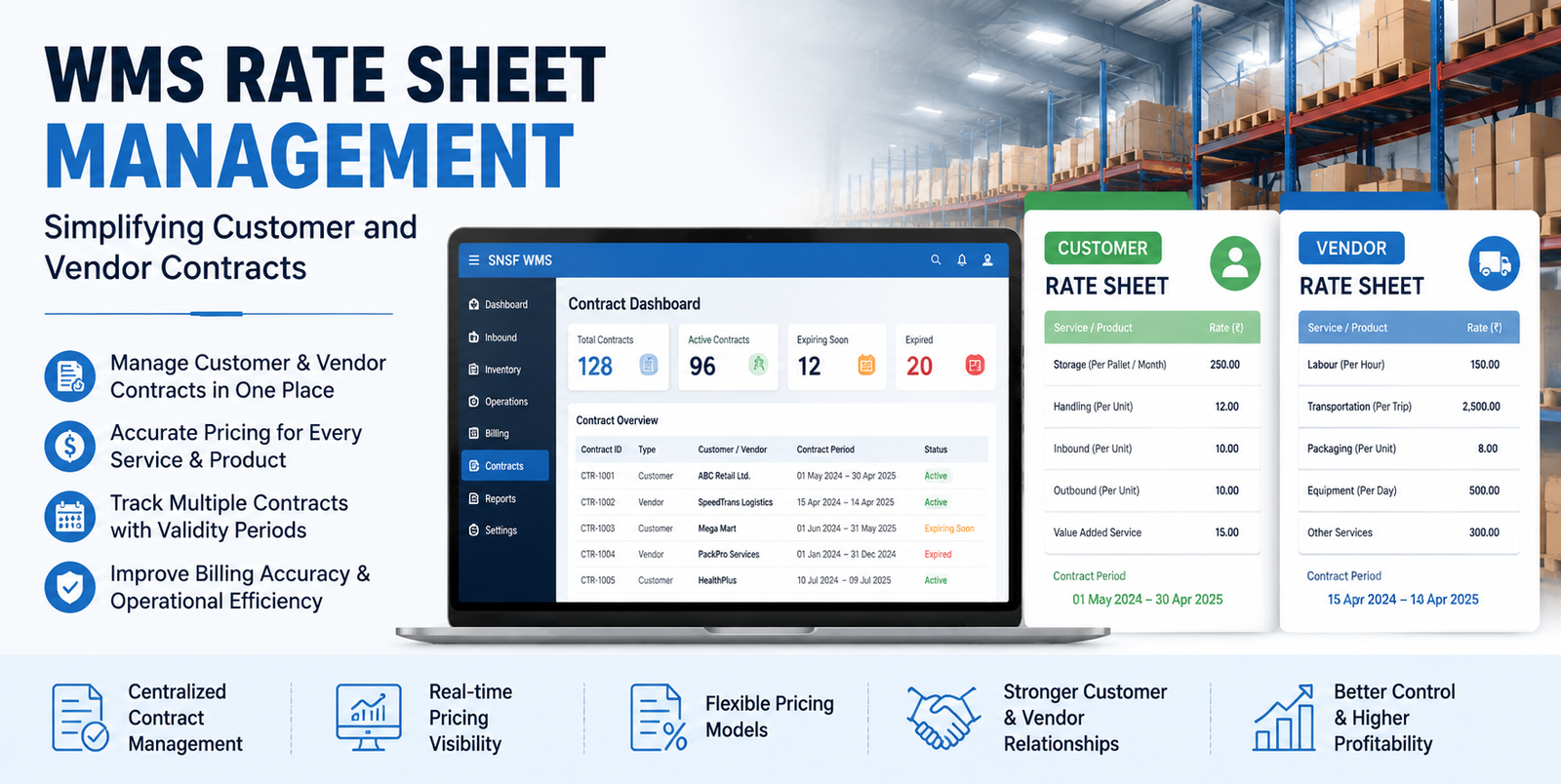
WMS Rate Sheet Management: Simplifying Customer and Vendor Contracts
For many warehouse and logistics companies, managing contracts with customers and vendors is a daily challenge. One warehouse can have multiple customers, each with different pricing arrangements related to storage, handling, packaging, transportation support, or value-added services. Vendors may also have different agreements depending on the services, locations, and contract durations.
If rate sheets are handled manually using spreadsheets, emails, or separate documents, teams may face difficulties finding the right pricing information during quotation, billing, and verification processes.
WMS rate sheet management enables businesses to organize customer and vendor pricing information within a structured warehouse management system. Since rate sheets, contract models, and pricing variations are maintained in one place, companies can improve accuracy, reduce manual work, and gain better control over warehouse commercial operations.
What Is WMS Rate Sheet Management?
WMS rate sheet management involves storing, organizing, and managing pricing agreements between customers and vendors within a Warehouse Management System.
Instead of maintaining separate rate sheets for different customers, services, or vendors, businesses can manage their pricing information through a centralized system.
A WMS-based rate sheet management system can help businesses maintain:
Customer-specific pricing
Vendor rate details
Product-based rates
Service-based charges
Contract validity periods
Different pricing models
For warehouse operators and 3PL providers, this provides better visibility into commercial agreements while supporting daily operational tasks such as quotation preparation and billing verification.
Why Warehouse Pricing Management Becomes Complex
Warehouse pricing varies according to customer requirements and service agreements.
Different Customer Pricing Models
Different customers have their own commercial requirements.
For example:
One customer may be charged for storage.
Another may use pricing based on handling.
A third customer may require different rates for inbound, outbound, and value-added services.
It can be difficult for teams to identify the correct rate when these variations are managed manually.
Multiple Contract Periods
Rates can change based on contract renewal periods or revised agreements.
For example:
A customer may have one storage rate for the first six months.
The service may have a revised rate when the contract is renewed.
Teams may accidentally use outdated pricing information if proper tracking is not maintained.
Vendor Pricing Variations
Warehouse businesses also obtain services from various vendors to meet their operational requirements.
Vendor agreements may include:
Labour charges
Transportation support
Packaging services
Additional warehouse activities
Keeping these costs separate can create difficulties when tracking and reconciling expenses.
Common Challenges With Manual Rate Sheet Management
Many businesses still maintain customer and vendor rate sheets using spreadsheets, emails, and handwritten records. Although this approach may be suitable for smaller operations, it becomes challenging as the number of customers, vendors, and contracts increases.
Common challenges include:
Spreadsheet Dependency
Having multiple versions of rate sheets can create confusion about which information is current and approved.
Incorrect Pricing References
When preparing quotations or invoices, teams may use outdated rates.
Slow Contract Verification
Operations and finance teams may need to spend additional time reviewing documents before confirming rates.
Billing Errors
Incorrect application of rate rules can lead to invoice corrections, customer disputes, or delayed approvals.
Difficulty Managing Multiple Contracts
Customers with different products, services, or contract periods require a more organized system than manual tracking can provide.
How Customer Contract Automation Helps Warehouses
Warehouse businesses can use customer contract automation to manage customer-specific pricing information through a structured system.
Instead of checking multiple documents, teams can maintain contract details within the WMS.
Customer contract automation helps businesses:
Store customer rate sheets centrally
Maintain different pricing models
Track contract validity periods
Reduce manual rate checking
Improve quotation preparation
Support accurate billing processes
This approach is beneficial for 3PL providers that manage multiple customers and need greater consistency in their commercial operations.
Why Vendor Rate Integration Matters in WMS
Warehouse operations depend on customer pricing as well as accurate vendor cost information.
Vendor rate integration enables businesses to maintain vendor charges within the same operational system.
This supports:
Better cost visibility
Improved vendor reconciliation
Easier tracking of service charges
More accurate operational costing
When vendor pricing information is properly organized, businesses can gain better understanding of service costs and maintain stronger financial control.
Multi-Contract Handling in Warehouse Operations
Most warehouse businesses manage several agreements with the same customer.
For example, a 3PL customer may have:
Storage contract
Handling service contract
Seasonal pricing agreement
Product-specific rate agreement
A warehouse pricing system should enable businesses to maintain different contracts without creating confusion.
With multi-contract handling, businesses can organize multiple agreements based on:
Customer
Product
Service
Warehouse location
Contract period
This enables teams to access the correct information while carrying out operational and commercial activities.
Manual Rate Management vs WMS Rate Sheet Management
Manual Rate Management
WMS Rate Sheet Management
Spreadsheet-based tracking
Centralized rate repository
Multiple document versions
Structured contract records
Manual rate verification
Faster access to pricing information
Higher possibility of errors
Better rate accuracy
Difficult multi-contract handling
Organized contract management
Slower quotation preparation
Improved quotation workflow
Best Practices for Warehouse Contract Management
Maintain Centralized Rate Records
To avoid confusion, keep customer and vendor pricing information in a single structured system.
Define Contract Validity Periods
Ensure that start dates, expiry dates, and updated pricing terms are maintained.
Standardize Contract Models
Set up consistent methods for handling different customer agreements.
Review Rate Changes Regularly
Regular reviews help ensure that teams are using updated pricing information.
Connect Contracts With Operational Workflows
Contract data should support quotation preparation, billing verification, and cost tracking.
How SNSF WMS Supports Contract Integration
SNSF WMS includes an integrated contract management feature that enables warehouse and logistics companies to manage contract information for customers and vendors.
The SNSF contract feature supports:
Customer contract management
Vendor rate integration
Multiple contract models
Product-wise and service-wise pricing
Multi-period contract handling
Centralized rate sheet management
By organizing customer and vendor rate information within the WMS, companies can reduce manual tracking and improve visibility during quotation, billing, and verification processes.
SNSF WMS is designed for logistics companies, warehouse operators, and 3PL providers that need better control over warehouse operations and commercial workflows.