Introduction
For many years, logistics companies have been digitizing their operations one function at a time. Warehouse teams have used WMS platforms. Transport departments have adopted TMS applications. Freight forwarders have digitized shipment and customs processes. Depot operators have introduced systems for gate, yard, and container management. Finance continues to work through ERP and accounting platforms.Each system is good at doing its specific job.The problem comes between these systems.A shipment does not stop being a shipment when it moves from freight forwarding to transportation. A warehouse dispatch can affect vehicle planning. A container movement can affect freight status, warehouse availability, and billing. A completed delivery can trigger documentation and financial processes.The physical operation is connected.The technology often is not.That is why the next step in logistics technology should not be about just adding another application. It should be about creating a logistics execution layer that connects operational data, events, decisions, and actions across the entire company.
The Problem With Digitizing Logistics One Function at a Time
There is nothing wrong with using specialty systems.A warehouse has different needs from a transport operation. Freight forwarding has different processes from container depot management. Finance has different controls from warehouse operations.The challenge begins when this specialization creates isolation.Consider a typical logistics organization.
The Warehouse System Knows
- What has been received
- Where inventory is stored
- What has been picked
- What is ready for dispatch
The Transport System Knows
- Which vehicle is available
- Which trip is scheduled
- Which driver is assigned
- Whether delivery has taken place
The Freight System Knows
- Shipment status
- Routing information
- Job details
- Customs and freight documentation
The Depot System Knows
- Container movements
- Gate activity
- Yard location
- Inspection or repair information
The Financial System Knows
- Customers
- Invoices
- Payments
- Financial transactions
Each system is accurate within its own boundaries.Yet the business may still lack a clear, reliable picture of what is happening.The question for executives is no longer simply:
Does each system work?
It is:
Can the organization trust that all these systems describe the same operational reality?
The Handoff Is Where Operational Friction Appears
Executives rarely see disconnected technology as an “integration problem.”They see it as operational friction.Questions begin to appear:
- Why is the shipment status different between two teams?
- Why is the warehouse waiting for transport?
- Why is the customer asking for a document that another department has?
- Why was an operational activity not billed?
- Why does finance need another spreadsheet?
- Why is management looking at yesterday’s information?
- Why are employees entering the same information more than once?
These are handoff problems.The information may already exist.The issue is that it does not move reliably from one operational stage to the next.This is why adding another dashboard does not solve the problem.A dashboard can show fragmented information.It cannot automatically make fragmented processes coherent.
What a Logistics Execution Layer Actually Means
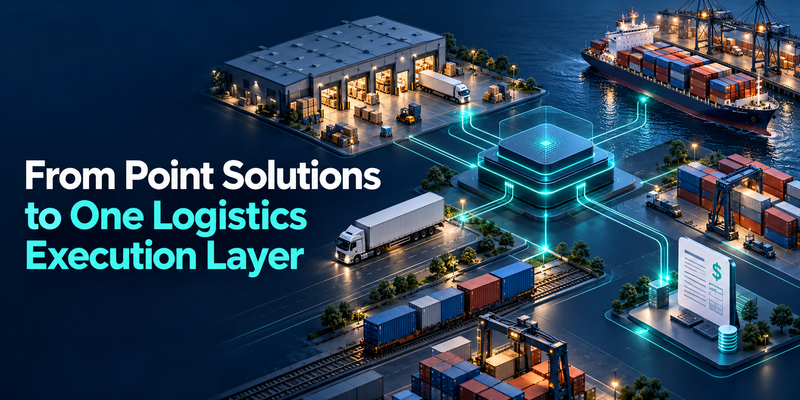
A logistics execution layer provides a shared operational context across different functions.It does not mean replacing every specialty application.Instead, the organization connects the relationships between:
Customer → Job → Shipment → Container → Warehouse → Transport → Documents → Delivery → BillingThe exact architecture may vary from one company to another.The principle remains the same:
An operational event in one part of the business should inform the next relevant process.
For example:
Freight shipment confirmed
↓
Warehouse receives inbound information
↓
Receiving team prepares for GRN
↓
Inventory becomes available
↓
Transport requirement is created
↓
Vehicle or trip is assigned
↓
Delivery is completed
↓
POD is captured
↓
Billing becomes readyThis is more than just application integration.It is process continuity.
The Data Layer Matters More Than the Dashboard
One common mistake in logistics transformation is to start with the executive dashboard.Management wants one screen.Operations wants real-time visibility.Finance wants accurate billing.Customer service wants shipment status.All of those requirements are valid.The dashboard’s reliability depends on the accuracy of the underlying operational data.If the warehouse uses one identifier for a customer, freight uses another, and finance uses a third, the organization ends up with multiple records for the same customer.This leads to confusion and inconsistencies.The same issue can occur with other entities such as:
- Job numbers
- Shipment references
- Container numbers
- Product codes
- Warehouse locations
- Vehicle IDs
- Service codes
- Billing references
Before investing in another reporting layer, the strategic question should be:
What are the core operational entities, who owns them, and how are they shared across the organization?
Answering this ensures that the data remains consistent and integrated.Warehouse management is responsible for warehouse execution, transportation management for transport, freight forwarding for freight processes, and depot management for container and yard processes.However, the relationships between customers, jobs, shipments, containers, inventory, documents, and billing should not end at the boundaries between these functions.This is especially important for third-party logistics providers (3PLs) and multi-site logistics operators.A customer may interact with several operational teams during a single shipment.If each team maintains a separate version of the transaction, customer service becomes responsible for reconstructing the entire story.If these events are connected, the organization can work from a common operational context.
The 3PL Challenge
For a 3PL, integration has an additional challenge.The organization needs shared infrastructure while maintaining customer-specific inventory, rates, service requirements, and reporting.Customer A’s inventory should not be confused with Customer B’s.At the same time, management needs an enterprise-wide view of:
- Warehouse capacity
- Inventory
- Customer activity
- Transport
- Freight
- Billing
- Service performance
- Exceptions
This creates a difficult requirement: customer-level control combined with enterprise-level visibility.A fragmented technology environment can solve one side better than the other.An execution-layer approach aims to support both.For example, customer-specific inventory, multi-warehouse operations, warehouse activities, and billing events can remain customer-specific while management receives a broader operational view.The strategic challenge is to maintain those controls without creating a separate technology silo for every customer.
Integration Should Be Designed Around Business Events
Technology teams often start integration discussions with APIs.APIs matter, but an API is not an operating model.The more important question is:
Which business events need to be exchanged?
Examples include:
- A warehouse event such as a Goods Receipt Note (GRN) being completed, which may trigger updates to inventory, order availability, notifications, and dispatch planning.
- A transport event such as a Proof of Delivery (POD) being captured, which may trigger closing a delivery, updating customer status, making billing information available, and storing supporting documentation.
- A depot event such as a container gate-in being completed, which may update container status and yard location, inform freight operations, and initiate the next required step.
- A commercial event such as a customer rate being updated, which may trigger updates to quotation information, billing references, contract history, and audit trails.
The goal is not to automate everything but to reduce unnecessary manual handoffs.
Before Approving Another Application, Ask Seven Questions
- What operational problem are we solving?
- Which existing systems already contain this information?
- Which operational events need to be exchanged?
- Who owns each piece of data?
- What happens when two systems disagree?
- How does the information affect billing and customer service?
- How will the result be measured?
Technology investment should connect to measurable operational outcomes.
The Execution-Layer Approach Is Also About Financial Control
The execution-layer approach is not only about operations; it is also about financial control.Consider contract logistics.A warehouse may perform:
- Storage
- Handling
- Repacking
- Loading
- Unloading
- Picking
- Dispatch
- Additional services
If these activities are recorded operationally but remain disconnected from the commercial process, billing gaps can occur.The key architectural principle is:
The event that creates the service should be connected to the event that creates the billable transaction.
This creates a direct relationship between operational execution and financial control.For the COO, this means better visibility.For the CFO, it can improve revenue control.For the CIO, it creates a clearer relationship between operational and financial data.
The Customer Sees One Supply Chain, Not Five Applications
There is another reason the execution layer matters.Customers do not think in software modules.They do not ask:
“Can I see the WMS status?”
They ask:
“Where is my shipment?”
Or:
“Has my inventory arrived?”
Or:
“When will my order be delivered?”
Or:
“Can you send me the document?”
The customer sees one supply chain.Internally, the answer may require information from five different teams.That gap between the customer’s view and the organization’s technology structure is becoming increasingly important.Customer self-service, digital documentation, and real-time communication all depend on trustworthy information moving across operational boundaries.
The Implementation Challenge Is Organizational, Not Just Technical
Operations, finance, customer service, and technology teams need to agree on how the business actually works.That requires process discovery.The implementation sequence should typically be:
Map the process
↓
Define operational entities
↓
Identify ownership
↓
Identify handoffs
↓
Define required events
↓
Connect systems
↓
Test real operating scenarios
↓
Measure outcomesThis sequence matters because integration built on an unclear process simply makes an unclear process move faster.Technology should follow the operating model.Not the other way around.
What the Next Generation of Logistics Technology Will Look Like
The future of logistics is unlikely to be a single giant application replacing every specialist system.It is equally unlikely to be an endless collection of applications connected through increasingly complicated interfaces.A more practical direction sits between the two.Specialized capabilities will remain.But organizations will increasingly need a common execution model that connects them.The progression can be viewed in five stages:
Stage 1 — Digitized Functions
WMS, TMS, freight, depot, and finance operate independently.
Stage 2 — Integrated Systems
Applications exchange selected information.
Stage 3 — Shared Operational Context
Customers, jobs, shipments, inventory, containers, vehicles, and documents are connected.
Stage 4 — Coordinated Execution
Events in one function automatically inform downstream processes.
Stage 5 — Decision Support
Operational data is used to identify exceptions, predict issues, and support better decisions.Organizations cannot reliably jump to Stage 5 while Stage 3 remains weak.AI cannot fix inconsistent master data.Predictive analytics cannot compensate for missing operational events.A control tower cannot create visibility that the underlying systems do not provide.The foundation remains connected operational data.
The Executive Decision Is Bigger Than Software Selection
For the CLO
Can the organization see and control the movement of goods across the network?
For the COO
Can operational events move from one team to the next without unnecessary manual intervention?
For the CIO
Can the technology architecture support shared data, integrations, security, and future growth without creating another set of silos?
For the CFO
Can operational activity be reliably connected to cost, billing, and profitability?
These are different questions.But they point toward the same strategic requirement.
From Applications to Execution
The logistics technology conversation has spent years asking:
Which WMS should we buy?
Then:
Which TMS should we buy?
Then:
How do we integrate them?
The more important question now is:
How should our logistics operation execute across systems, locations, customers and transport modes?
That is the shift from applications to execution.The goal is not to eliminate specialization.It is to eliminate unnecessary separation.A warehouse should remain a warehouse operation.A transport team should remain a transport operation.A freight forwarder should retain its specialized workflows.A depot should retain its operational controls.But the organization should not have to reconstruct the same shipment, customer or job story every time information crosses a departmental boundary.The future of logistics technology will be defined less by how many applications an organization owns and more by how effectively those applications work together around one operational reality.That is what a logistics execution layer should ultimately provide:
- One operational context.
- Connected events.
- Clear ownership.
- Fewer manual handoffs.
- Better decisions.
And ultimately, a logistics operation that executes as one business rather than as a collection of disconnected functions.