A supply-chain disruption rarely stays within one part of the business. A delayed supplier can create an inventory shortage. An inventory shortage can affect warehouse allocation. That can change transport requirements. A delayed shipment can affect customer commitments, operating costs, and revenue.
Yet many organizations still manage these events through separate teams, systems, and spreadsheets.
That creates a difficult question for supply-chain executives:
Can the organization identify a disruption early enough to understand its impact and act before it becomes a customer or financial problem?
Supply-chain resilience is increasingly becoming an operating capability rather than a contingency exercise. The World Economic Forum's Global Value Chains Outlook 2026 describes persistent volatility as a structural condition and reports that 74% of business leaders view resilience as a driver of growth. The report emphasizes orchestration, distributed scale, and optionality as ways to build greater agility.
For logistics and supply-chain leaders, the implication is straightforward: resilience cannot depend only on additional inventory or a crisis-response plan. It requires better visibility, connected operational data, alternative options, and the ability to execute decisions quickly.
A supply chain resilience strategy is a structured approach for preparing an organization to anticipate, absorb, respond to, and recover from disruptions while protecting critical operations and customer commitments.
It combines:
Resilience is therefore not owned by procurement alone.
A disruption can cross procurement, warehousing, freight, transportation, finance, customer service, and IT within hours.
The organization needs these functions to work from a sufficiently consistent operational picture.
The traditional supply-chain objective was often straightforward:
Minimize cost while maintaining service.
That model becomes harder when disruption is persistent.
Geopolitical changes, trade restrictions, infrastructure constraints, supplier concentration, transport disruptions, and changing customer expectations can alter the economics of a network.
The World Economic Forum's 2026 research describes this environment as structural volatility rather than a temporary cycle and argues for supply chains designed around greater flexibility and optionality.
For executives, this changes the investment question.
It is no longer simply:
“How much will resilience cost?”
It becomes:
“What is the cost of being unable to respond when a critical dependency fails?”
That cost can include:
The right resilience strategy therefore balances protection, flexibility, and cost.
A company cannot respond effectively to a risk it cannot see.
This sounds obvious, but supply-chain visibility often stops too early.
McKinsey's 2026 research notes that many organizations have visibility into Tier 1 supplier risks but considerably less visibility further down the supply chain. The research also highlights the continued use of inventory buffers as companies manage uncertainty.
The same principle applies to logistics execution.
An organization may know:
But that does not necessarily mean it knows the business impact of a change.
A delayed shipment becomes strategically important when the organization can connect it to:
Shipment → Inventory → Customer Order → Warehouse → Transport → Service Commitment
That is the difference between tracking an event and understanding its consequences.
A dashboard can tell an executive that a shipment is late.
A resilient operating model needs to answer several additional questions:
This is why visibility should be viewed as the starting point of resilience rather than the final objective.
The real progression is:
Visibility → Impact Assessment → Decision → Action → Recovery
Many risk assessments begin with a list of risks:
A stronger approach maps the dependencies behind those risks.
Consider a critical imported product:
Supplier → Origin → Port → Freight → Customs → Warehouse → Transport → Customer
Now ask what happens if each link is disrupted.
This produces a more useful resilience assessment because it connects the external disruption to the internal operating consequences.
Inventory is an important protection mechanism.
But it is not a complete resilience strategy.
Excess inventory can:
McKinsey's recent research highlights the tension between inventory buffers and longer-term resilience investments, noting that companies continue to use inventory as a response to uncertainty while also reassessing their supply-chain footprints and visibility capabilities.
A more balanced strategy considers several forms of resilience:
What stock is required to absorb predictable disruption?
Which critical inputs have alternative sources?
Which alternative carriers, routes, or modes are available?
Can another facility absorb demand?
Can the organization identify the problem early?
Can the right person approve an alternative quickly?
Resilience is strongest when these mechanisms work together.
Operational data is often distributed across different systems.
Warehouse teams manage inventory and receiving.
Freight teams manage shipment and customs information.
Transport teams manage trips and deliveries.
Depot teams manage containers and yard activity.
Finance manages billing and financial records.
When these systems are disconnected, a disruption can require manual reconciliation before anyone understands its full impact.
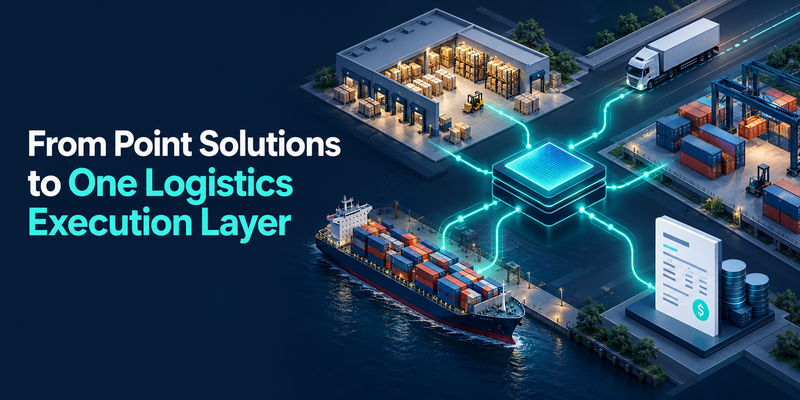
An integrated logistics environment can connect operational entities such as:
Store’n Ship-Fast currently positions its Logistics ERP platform around connected warehouse, freight forwarding, transportation, depot, document, CRM, quotation, billing, and reporting workflows.
The strategic principle is broader than any one platform:
Resilience improves when the organization can connect an operational event to the downstream activities it affects.
A resilient supply chain should treat exceptions as part of normal operations.
Projected stock falls below the required level.
Response: Check alternative inventory, supply options, and customer priorities.
A shipment misses a milestone.
Response: Assess customer impact, alternative routing, and revised delivery expectations.
A vehicle becomes unavailable.
Response: Identify alternative capacity and update delivery planning.
Capacity becomes constrained.
Response: Review inventory priorities, storage allocation, and outbound schedules.
A required document is incomplete.
Response: Identify the responsible party and prevent the document issue from blocking the shipment.
Each exception should have:
Trigger → Owner → Impact → Decision → Action → Escalation → Resolution
Without that structure, visibility simply creates more information for people to review.
The term “control tower” is often associated with a centralized dashboard.
But a dashboard is only the visible part of a control-tower model.
A useful control tower should connect:
Data
↓
Event
↓
Exception
↓
Impact
↓
Recommended response
↓
Decision
↓
Execution
For example:
Shipment delayed
↓
Customer order at risk
↓
Check alternative inventory
↓
Check alternative transport
↓
Compare cost and service impact
↓
Approve response
↓
Update warehouse and transport plans
The objective is to shorten the time between knowing about a problem and taking action.
There is a temptation to introduce advanced analytics or AI as soon as resilience becomes a priority.
But advanced decision support depends on reliable operational data.
If:
then predictive models have a weak foundation.
McKinsey's 2026 research emphasizes the importance of visibility, scenario planning, and continual reassessment of supply-chain vulnerabilities.
The practical sequence should therefore be:
Connected data → Reliable events → Analytics → Prediction → Decision support
not:
AI → instant resilience
Once operational data is sufficiently reliable, AI can support several resilience decisions.
Potential applications include:
The important question is not:
“Where can we add AI?”
It is:
“Which decisions would benefit from earlier prediction or better analysis?”
That keeps technology investment tied to an operational outcome.
The World Economic Forum's 2026 research emphasizes orchestration, distributed scale, and optionality as important components of resilient supply chains.
For logistics organizations, optionality may include:
But optionality is not free.
Maintaining every possible alternative would create unnecessary cost and complexity.
The better approach is to identify the dependencies where an alternative is genuinely valuable.
For each critical dependency, ask:
This creates a practical resilience portfolio.
Resilience decisions always involve trade-offs.
An alternative transport route may protect service but increase cost.
Additional inventory may reduce stock-out risk but increase working capital.
A second warehouse may provide capacity but increase fixed costs.
A second supplier may reduce dependency but increase procurement complexity.
The executive decision should therefore consider:
Service impact + operational impact + financial impact
rather than treating resilience as an operational issue alone.
A useful decision framework is:
| Option | Service Impact | Cost Impact | Response Time | Flexibility |
|---|---|---|---|---|
| Existing route | Low/High | Baseline | Baseline | Low |
| Alternative route | Lower risk | Higher | Medium | Medium |
| Alternative supplier | Lower dependency | Variable | Longer | High |
| Additional inventory | Lower short-term risk | Higher working capital | Fast | Medium |
| Alternative warehouse | Lower capacity risk | Higher operating cost | Medium | High |
The exact values should come from the organization's own data rather than generic benchmarks.
Supply-chain resilience is often measured internally.
Customers experience it externally.
If a shipment is delayed, the customer wants an answer.
If inventory is unavailable, the customer wants an alternative.
If delivery timing changes, the customer needs an updated commitment.
This makes communication part of resilience.
A connected operating model should help customer-facing teams understand:
The objective is not to hide disruption.
It is to provide customers with accurate information early enough for them to plan.
Organizations can build their resilience program around seven steps.
Map critical suppliers, products, customers, lanes, warehouses, ports, carriers, and service commitments.
Create reliable relationships between customers, orders, inventory, shipments, transport, warehouses, documents, and costs.
Establish thresholds for inventory, shipment, capacity, transport, and documentation exceptions.
Determine which customers, services, inventory positions, and financial commitments are affected.
Define alternative suppliers, routes, carriers, warehouses, and fulfillment methods.
Make it clear who can approve additional cost, change routing, reallocate inventory, or communicate customer-impacting changes.
After every major disruption, review what happened, how quickly the organization responded, what the response cost, and what should change.
This turns resilience into a repeatable management discipline.
A resilience strategy should be tested with five simple questions:
If not, improve monitoring and data availability.
If not, map dependencies between suppliers, inventory, logistics, and customers.
If not, identify critical single points of failure.
If not, clarify decision rights and escalation processes.
If not, connect the relevant systems and workflows.
These questions provide a practical way to assess resilience without starting with a technology purchase.
The next generation of resilience will not be built around a single system, dashboard, or AI model.
It will be built around an operating model that combines:
The organizations that perform best during disruption will not necessarily be those that predict every event.
They will be the organizations that can sense change early, understand its consequences, and respond without losing control of the operation.
That is the real shift from crisis management to supply-chain resilience.
Supply-chain resilience should no longer be treated as a document that is reviewed when a crisis occurs.
It should be part of everyday operational management.
The objective is not to eliminate every possible risk. No organization can do that.
The objective is to build enough visibility, flexibility, and response capacity to protect critical customers and operations when conditions change.
That requires a move from:
For the CLO, resilience is about protecting service.
For the COO, it is about maintaining operational continuity.
For the CIO, it is about creating the data and technology foundation that allows the business to respond.
For the CFO, it is about balancing resilience with cost and working capital.
The strategic question is therefore not simply:
“How resilient is our supply chain?”
It is:
“How quickly can our organization turn a disruption signal into an informed operational response?”
That is the measure of resilience that matters.